
Baggage During IROPS: The Operational Problem Airlines Keep Underestimating
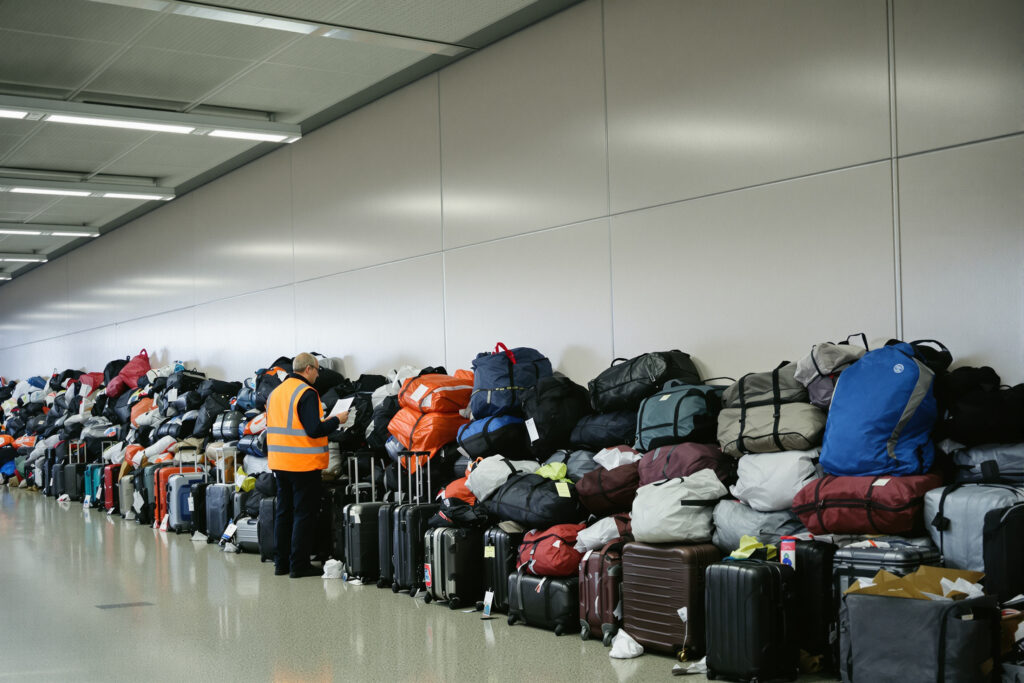
When the Flight Stops, the Bags Do Not
Passenger reaccommodation during a major disruption gets most of the attention. Hotels, ground transport, meal vouchers, rebooking queues: these are the visible, pressurized problems that operations teams scramble to solve in the first hour. Baggage, by contrast, tends to get treated as a secondary problem, something to resolve once the passengers are handled.
That sequencing is a mistake. In practice, baggage handling failures during IROPS generate a disproportionate share of passenger complaints, EU261 escalations, and duty-of-care claims. They also create cascading operational problems that are far harder to resolve the longer they are left unaddressed.
This post looks at why baggage management breaks down specifically during disruptions, what the knock-on consequences are, and what a more structured approach looks like in practice.
Why IROPS Breaks Normal Baggage Flows
Under normal operations, baggage handling is a tightly choreographed process that depends on predictable flight sequences, stable aircraft assignments, and coordinated ground handling handoffs. IROPS destroys all three simultaneously.
When a flight is cancelled or a significant delay triggers reaccommodation across multiple carriers or routing alternatives, bags that have already been loaded may sit in the hold of an aircraft that is no longer going anywhere. Bags checked in but not yet loaded may be held in a sorting area with no clear destination. Passengers rebooked onto alternative flights are often on different aircraft, different terminals, and sometimes different airports entirely, while their baggage remains behind on the original itinerary.
The problem compounds quickly. Ground handling teams working under disruption pressure prioritize aircraft turnarounds. Airline staff at the gate prioritize boarding. No single function owns the full baggage recovery process, and in the absence of clear ownership, bags stop moving.
The Passenger Experience Consequences Are Serious
A passenger who is successfully reaccommodated to a hotel and rebooked on a morning flight has, in principle, been taken care of. But if their bag is still at the origin airport with no confirmed transfer plan, their experience deteriorates rapidly.
They may not have toiletries, a change of clothes, or medication. If the disruption extends across multiple days, this moves from inconvenience to a genuine duty-of-care issue. Under EU261 and related regulations, airlines have obligations around care and assistance that extend beyond hotel and meals, and the absence of essential personal items can become part of a compensation claim.
Passengers who manage the rest of a disruption with reasonable patience often become significantly more difficult to handle once they discover their bag is lost or delayed with no information. At that point, the reaccommodation goodwill that was built earlier disappears.
The Operational Consequences Are Just as Costly
Beyond passenger experience, unresolved baggage situations during IROPS create direct operational costs. Bags that are not reconciled with passengers before aircraft departure create security compliance issues. Bags loaded onto wrong aircraft create rerouting problems. Bags left in limbo at a hub during a multi-day weather event can accumulate to the point where the backlog becomes structurally difficult to clear even after operations normalize.
There are also downstream effects on the stations handling recovery. Ground handling teams at airports absorbing diverted or recovered traffic are often already stretched. Arriving with large volumes of unreconciled baggage from upstream disruptions adds pressure they are not resourced for.
What a Structured Baggage Response During IROPS Looks Like
The most effective operations teams treat baggage management as a parallel workstream during disruptions, not a follow-on task. That means a few concrete things in practice.
- Clear ownership: Someone in the operations center has explicit responsibility for baggage status during a disruption event. This is not the gate agent’s problem or the ground handler’s problem alone. It requires a coordination point with visibility across the event.
- Passenger communication: Affected passengers should receive proactive information about their bag’s status as soon as a diversion or cancellation is confirmed. Telling a passenger that their bag will follow on the next available service, with a specific reference number and contact point, removes a significant source of anxiety and complaint volume.
- Transfer protocols agreed in advance: Reaccommodation agreements with partner carriers should include clarity on baggage transfer procedures. This is often overlooked in interline agreements that focus primarily on ticketing and seat allocation. If the bag transfer process is not defined in advance, it will not happen reliably under pressure.
- Ground transport as a recovery tool: In some disruption scenarios, particularly short-haul diversions within a few hours’ drive, ground transport is a faster and more controllable option for returning both passengers and their bags to the intended destination. This is worth building into diversion response plans explicitly. You can see how dedicated ground transport solutions fit into disruption response at Duerming’s transport solutions page.
- Delay documentation for delayed baggage claims: Every bag separated from its passenger during an IROPS event should have a documented chain of custody. This protects the airline against inflated or fraudulent delayed baggage claims and provides the evidence base needed if a passenger dispute escalates.
The Supplier Coordination Problem
Airlines rarely handle baggage directly. Ground handling is typically contracted, and during major disruptions, ground handlers are managing multiple airlines simultaneously, often under their own resource constraints. This means that baggage recovery during IROPS requires the airline to actively manage its ground handling supplier rather than assuming the process will run itself.
Operations managers who have experienced this describe a consistent pattern: under normal operations, the ground handler performs reliably. Under disruption conditions, without active airline-side coordination, priorities shift toward tasks with more immediate visibility, and baggage resolution falls behind.
The same dynamic applies to how IROPS partners are integrated into the response. A provider managing hotel and ground transport for disrupted passengers is often the most direct point of contact with those passengers during a multi-hour or multi-day event. That means they can also serve as a communication channel for baggage updates, reducing the volume of calls hitting the airline’s own contact centers. This is one of the less obvious operational benefits of working with a specialist IROPS partner rather than managing accommodation and transport through ad hoc arrangements. More on how that integration works in practice at Duerming’s airline and crew solutions page.
Building Baggage Into the IROPS Playbook
Most airline IROPS playbooks cover reaccommodation logic, hotel capacity triggers, crew rest requirements, and escalation protocols in reasonable detail. Baggage procedures are often either absent or described at a level of abstraction that provides no operational guidance during an actual event.
The practical fix is not complicated. It requires adding a baggage workstream owner to the disruption response structure, defining communication templates for affected passengers, confirming transfer protocols with interline partners, and including baggage reconciliation checkpoints in the event closeout process.
None of this requires new technology or significant investment. It requires treating baggage as a first-class part of the disruption response rather than an afterthought. Given the proportion of passenger dissatisfaction and regulatory exposure that traces back to baggage failures, the operational case for doing so is straightforward.
Ready to be prepared before the next disruption?
Talk to our operations team about a standing IROPS agreement for your airline.